

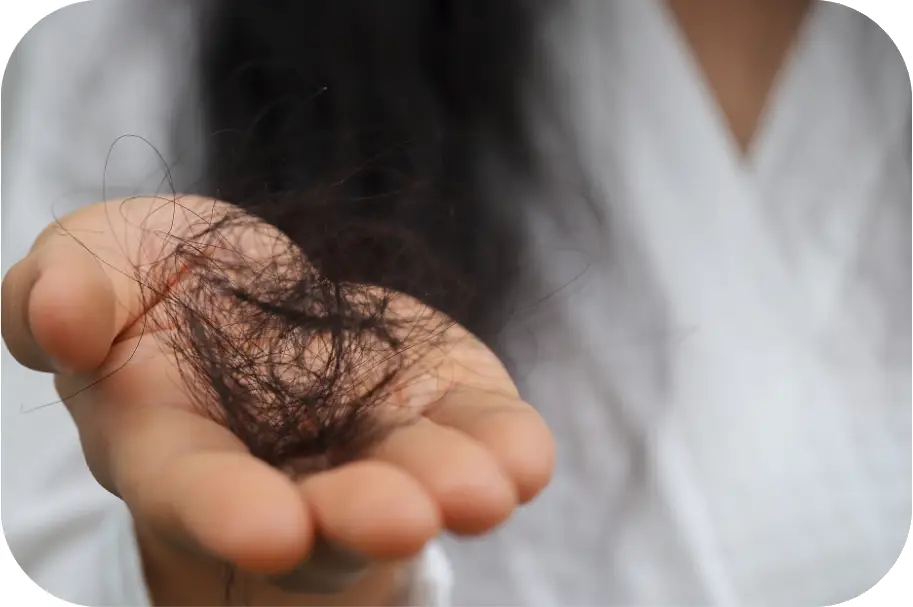
Medications like semaglutide and tirzepatide (GLP-1 and GIP/GLP-1 receptor agonists) have transformed metabolic health and weight loss. But some patients notice increased hair shedding a few months into treatment and understandably worry: Is the medication causing this?
The short answer: It’s usually not the drug itself — it’s the metabolic shift.
Clinical and dermatologic research suggests that the hair shedding some patients experience while using GLP-1 or GIP/GLP-1 medications is most consistent with telogen effluvium, a temporary shift in the hair growth cycle triggered by metabolic stress. Retrospective and review-level studies indicate that this shedding correlates more strongly with rapid weight loss, caloric restriction, and nutritional changes rather than direct toxicity to the hair follicle from the medication itself. In most cases, hair growth resumes once nutritional intake improves and the body adapts to its new metabolic baseline.
This type of shedding is called telogen effluvium — a temporary condition that happens when the body experiences:
It can occur after bariatric surgery, crash dieting, illness, childbirth — and yes, meaningful metabolic weight loss.
Hair grows in cycles, with approximately 85–90% of scalp hairs in the active (anagen) growth phase at any given time. When the body experiences physiologic stress — including rapid weight loss or under-fueling — a larger proportion of follicles prematurely shift into the resting (telogen) phase.
Shedding typically becomes noticeable 2–4 months after the trigger, which explains why patients often see hair changes several months into treatment.
This form of shedding is diffuse rather than patchy and, in most cases, is reversible once the underlying stressor is corrected.
Hair loss from:
is different from weight-loss-related shedding.
With GLP-1/GIP therapy, hair thinning is typically caused by:
Hair is primarily made of keratin — a protein. When intake drops, the body prioritizes vital organs over hair growth.
The encouraging news:
When nutrition improves and weight stabilizes, follicles re-enter the growth phase.
In most cases, yes.
Hair shedding related to rapid weight loss is typically consistent with telogen effluvium, a temporary shift in the hair growth cycle. Dermatology literature notes that once the underlying trigger — such as caloric restriction, metabolic stress, or micronutrient deficiency — is corrected, hair growth generally resumes.
According to sources such as the Cleveland Clinic and StatPearls (NCBI Bookshelf), recovery depends on correcting the underlying stressor. Age, genetics, iron status, thyroid function, and overall nutritional adequacy all influence the pace of regrowth.
Importantly, telogen effluvium does not permanently damage the hair follicle, and regrowth is expected once metabolic balance is restored.
1. Prioritize Protein
Many patients on GLP-1 medications unintentionally under-consume protein because appetite decreases.
According to the American Journal of Clinical Nutrition, protein intake should be higher during weight loss and aging states. For hair follicle support and lean-mass preservation, aim for:
• ~1.2–2.0 g protein per kilogram of body weight per day
• Distribute protein evenly across meals
• Use supplementation if daily intake is difficult to reach
Adequate protein intake is protective — during weight loss, it helps maintain muscle, metabolic rate, and normal hair growth cycling rather than allowing the body to shift resources away from follicles.
Hair follicles are highly sensitive to metabolic and micronutrient shifts. During weight loss or physiologic stress, deficiencies may contribute to prolonged shedding.
Consider evaluating:
Correcting deficiencies often improves recovery time and hair density. In some cases, a targeted multivitamin or hair-support formula may help fill nutritional gaps. We offer Hair Force One, a compounded blend of essential vitamins and minerals designed to support cellular health, keratin production, and overall scalp and follicle function.
3. Avoid Aggressive Weight Loss
Faster isn’t always better.
Steady, personalized dosing and sustainable weight reduction reduce physiologic stress — and may decrease hair shedding risk.
4. Gentle Hair Care
While it won’t stop telogen effluvium, minimizing external stress helps:
GLP-1 and GIP medications do not directly “damage” hair follicles.
They improve insulin resistance, inflammation, and metabolic health — which long term can actually support healthier hair growth.
Temporary shedding can occur when the body is adapting to:
The solution is not stopping therapy prematurely — it is optimizing nutrition while improving metabolic health.
If you notice increased shedding while on semaglutide or tirzepatide:
In most cases, hair regrows once the body stabilizes.
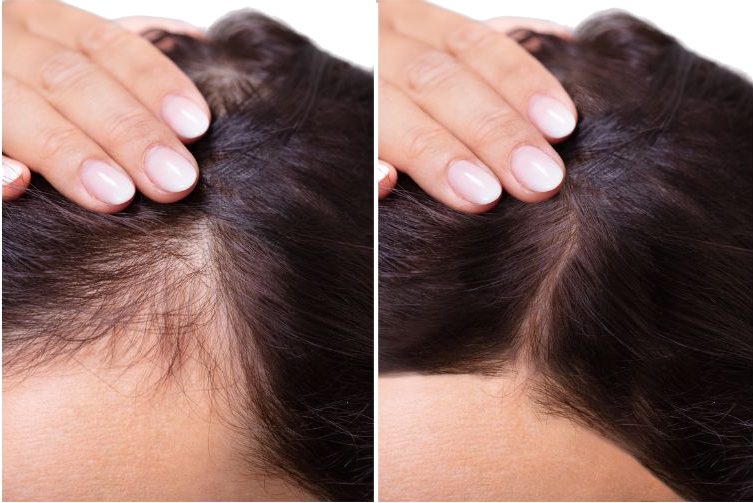
Weight loss should improve your health — not compromise it.
When approached strategically, you can support both metabolic transformation and hair vitality.
Almohanna HM, Ahmed AA, Tsatalis JP, Tosti A. The role of vitamins and minerals in hair loss: A review. Dermatol Ther (Heidelb). 2019;9(1):51-70.
Harrison S, Sinclair R. Telogen effluvium. Clin Exp Dermatol. 2002;27(5):389-395.
Malkud S. Telogen effluvium. In: StatPearls. Treasure Island, FL: StatPearls Publishing; 2024.
Phillips SM, Chevalier S, Leidy HJ. Protein “requirements” beyond the RDA: Implications for optimizing health. Appl PhysiolNutrMetab. 2016;41(5):565-572.
Weinheimer EM, Sands LP, Campbell WW. Effects of energy restriction and exercise on fat-free mass. Am J Clin Nutr. 2010;92(4):867-879.
Rasheed H, Mahgoub D, Hegazy R, et al. Serum ferritin and vitamin D in female hair loss: Do they play a role? Int J Dermatol. 2013;52(3):326-331.Deutz NEP, Bauer JM, Barazzoni R, et al. Protein intake and exercise for optimal muscle function with aging: Recommendations from the PROT-AGE Study Group. Am J Clin Nutr. 2015;101(6 Suppl):1320S-1328S.